Andrographis / Chuan Xin Lian |
View All Products |
Product Code: CLS-11285
|
Andrographis Paniculata / Chuan Xing Lian
Description
Andrographis is the herb of Andrographis paniculata, a flowering plant in the Acanthaceae family. The perennial grows wild in thickets throughout south Asia, although it also may be cultivated. In summer and autumn, clusters of small white flowers appear; it is harvested when the flowers begin to bloom. It is traditionally valued as an herbal remedy in China, where it grows in the Guangdong, Guangxi, Fujian, Yunnan, Sichuan, Jiangsu, and Jianxi provinces.
In Mandarin, andrographis is called chuan xin lian, Yi jian xi and Lan he lian, which translate directly as "thread-the-heart lotus." The Cantonese term is chyun sam ling, and the Japanese call it senshinren. English common names include green chiretta, heart-thread lotus leaf, and kariyat. Its pharmaceutical names, used to distinguish it as a medicine, are Herba Andrographitis Paniculatae or alternately Folium Andrographis.
General use
Practitioners of Chinese medicine believe that andrographis affects the large intestine, lung, stomach, bladder, and liver meridians, or energy pathways in the body. It is thought to dispel heat (such as that associated with fever or infection) and is used primarily as a broad-spectrum antibiotic and immunostimulant for a variety of bacterial, viral, and parasitic conditions, including influenza, intestinal infections, hepatitis, pneumonia, and infected wounds. Andrographis's medicinal properties are considered very bitter, astringent, cold, dry, and stimulating.
Andrographis is considered most effective for conditions associated with fever, inflammation, and the formation of pus. It clears heat and relieves "fire toxicity" manifest as sores and carbuncles on the skin. It is also applied topically for snakebite and eczema. Under the supervision of a qualified practitioner, it is used as a uterine stimulant and abortive, to bring on miscarriage or treat prolonged pregnancy or retained placenta.
Andrographis can also be used as an inexpensive substitute for another Chinese herb, coptis (huang lian).
Research on andrographis has generally been conducted in China and has focused on pharmacological investigation. Studies indicate that andrographis cultivated in the plains of Shanghai has significant immune stimulating and anti-infective qualities. In vitro, it inhibits the growth of Diplococcus pneumoniae and other bacteria and delays the deterioration of embryonic renal cells caused by a virus.
Major chemical ingredients include andrographan, andrographolide, neoandrographolide, paniculide A, 14-deoxy-11-oxyandrographolide, and beta-sitosterol.
Preparations
Andrographis is not generally available in American health food stores, but it can be found at most Chinese pharmacies and Asian groceries.
The standard dose ranges from 10-15 grams as a decoction (strong tea) or 2-5 milliliters as a tincture. Powder doses range from 0.6 to 1.2 grams. Because the herb is extremely bitter, it's recommended that powder be taken in capsule form.
Practitioners of Chinese medicine commonly combine andrographis in patent formulas along with other Chinese herbs. The following are the major herbs with which it is combined and the symptoms for which the combinations are prescribed.
* Pericarpium Citri Reticulatae (Citrus reticulata, Chen pi) for cough associated with Lung heat.
* Herba et Radix Houttuyniae Cordatae ( Houttuynia cordata, yu xing cao) and Semen Benincasae Hispidae (Benincasa hispida, dong gua ren cao) for Lung abcess.
* Flos Lonicerae Japonicae (Lonicera japonica, jin yin hua) and Radix Platycodonis Grandiflori (Platycodon grandiflorum, jie geng) for early stages of a disease with fever and sore throat.
* Herba Portulacae Oleraceae (Portulacca oleracea, ma chi xian ) for dysentery.
* Radix et folium Polygoni Cuspidati (Polygonum cuspidatum, hu zhang) and Rhizoma Imperatae Cylindricae(Imperata cylindrical var. major, bai mao gen) for hot, painful urinary disfunction.
Precautions
According to tradition, andrographis is never used in cases of deficient, cold intestinal conditions. When used long-term or in large doses, this bitter and cold herb may damage stomach qi, causing gastric distress and loss of appetite.
Andrographis is also capable of producing a miscarriage, and thus should be avoided by pregnant women unless otherwise directed by a knowledgeable practitioner.
Side effects
Gastric distress and loss of appetite have been noted when the herb is taken in large doses.
Interactions
No interactions with pharmaceutical drugs have been noted.
Key Terms
Cold
In Chinese pathology, the term defines a condition that has insufficient warmth, either objective (hypothermia) or subjective (feeling cold).
Decoction
A strong tea brewed for 20-30 minutes.
Heat
In Chinese pathology, the term defines a condition that has excessive heat, either objective (fever, infection) or subjective (feeling hot).
Meridians
Energetic pathways inside the body through which flows; also called channels.
Patent formulas
Chinese herbal formulas that were patented centuries ago and are believed to be proven over centuries of use and study.
Tincture
A solution of medicinal substance in alcohol, usually more or less diluted. Herb tinctures are made by infusing the alcohol with plant material.
Qi
A Chinese medical term denoting active physiological energy.
Further Reading
For Your Information
Books
* Bensky, D. and Gamble, Andrew. Chinese Herbal Medicine: Materia Medica. Revised ed. Eastland Press, 1993.
* Hsu, Hong-Yen, et. al. Oriental Materia Medica: A Concise Guide. Oriental Healing Arts Institute, 1986.
* Holmes, P. Jade Remedies: A Chinese Herbal Reference for the West. Snow Lotus Press, 1996.
* Fan, W.. A Manual of Chinese Herbal Medicine: Principles and Practice for Easy Reference. Shambala, 1996.
Gale Encyclopedia of Alternative Medicine. Gale Group, 2001.
Andrographis paniculata: A Review
by Roger Lewis, C.H.
Introduction
Andrographis paniculata is a promising new herb for the treatment of many diseases, including HIV, AIDS, and the myriad of symptoms associated with autoimmune disorders. This review is an attempt to conglomerate the available information regarding Andrographis paniculata, and is not intended to be diagnostic or prescriptive in nature.
Background
Several references exist in which Andrographis paniculata is mentioned to varying degrees, usually in the context of HIV. One report is presented at the end of this review as a reprint, because it is no longer available to the public from the manufacturer, Ecological Formulas of Concord, California, due to FDA regulations governing the permitted claims associated with "unproven" drugs. The report focuses primarily on the role of Andrographis paniculata in the treatment of heart diseases, but several important issues are discussed which are relevant to HIV. Two other reports mention Andrographis paniculata briefly: the 1993 GAIA Herb Conference notes lists the outline of a lecture by Ed Ellis, Nd., which includes Andrographis paniculata, as dose a brief list of useful Chinese herbs in the book AIDS: Hope, Hoax, and Hooplah by Michael Culbert, D.Sc.
Inhibits HIV
Most interesting is the Ecological Formulas report, which states that "Andrographolide esters have been found to be inhibitors against the HIV virus in vitro. It was non-toxic to the H9 cell at concentrations of 1.6 - 3.1 mcg/ml. It was also inhibitory to two other strains of HIV-1 and a strain of HIV-2." This research has culminated in the release of Andro Vir, a patented drug produced by Paracelsian Inc., and derived from Andrographis paniculata. An internet search on Infoseek for Paracelsian or Andro Vir reveals interesting clinical data regarding trials, but little if any data on the herb itself.
New AIDS Drug From Herb
One test showed early results of a "...nine week study on 16 HIV-infected subjects, AndroVir caused half of them to have a 31% increase in CD4+ cell counts" and a "38% decrease in the amount of HIV in their blood." Paracelsian has since released a similar product for cancer, and the Ecological Formulas report below describes some details of cancer research involving Andrographis paniculata.
Seven Active Constituents
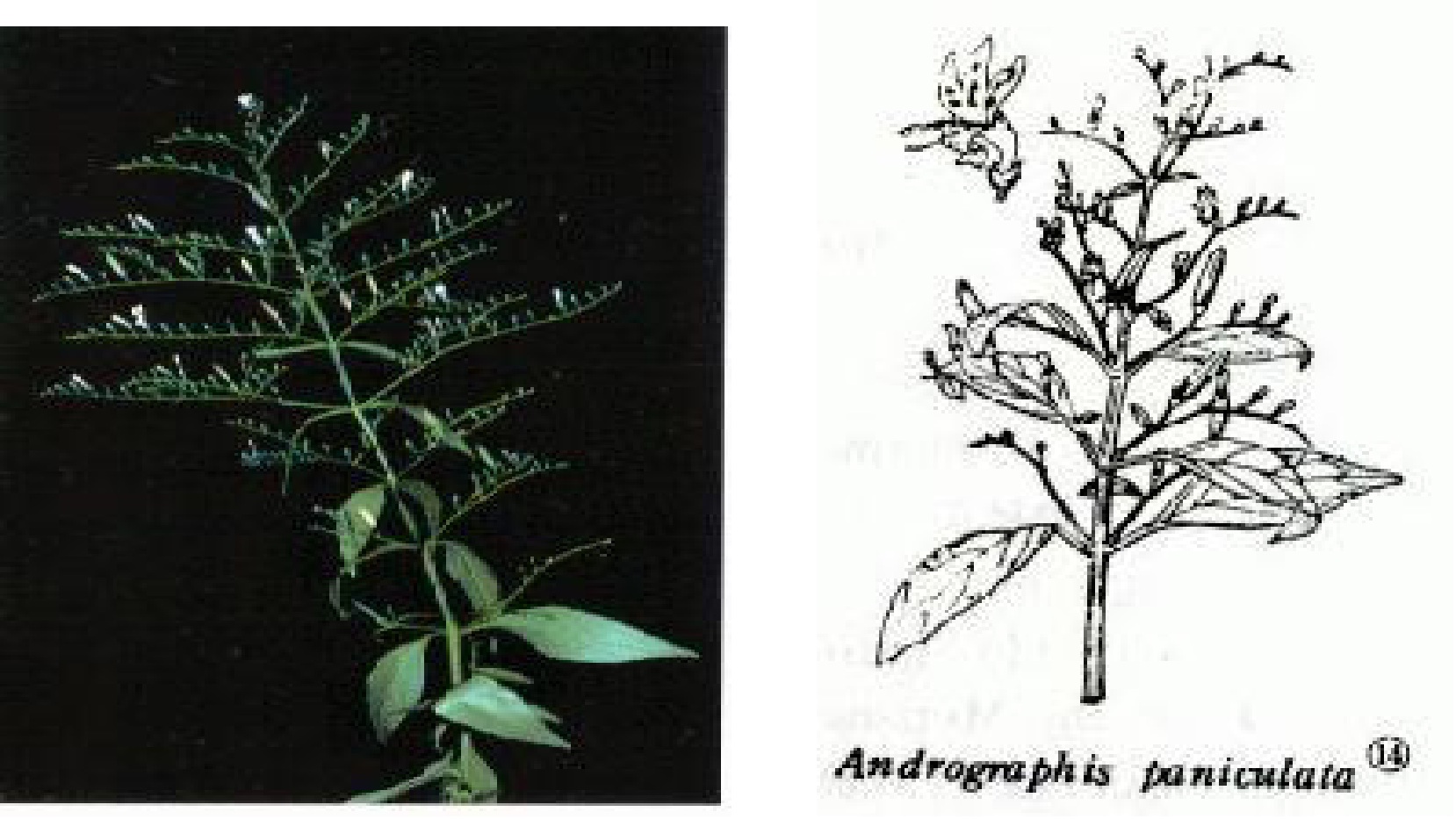
The primary active ingredient in Andrographis paniculata appears to be andrographolide, although two Chinese texts list a broader range of 6 additional constituents. The ingredients other than andrographolide are neoandrographolide; paniculide; A, B, & C 14-deoxy-11-oxoandrographolide; and 14-deoxy-11-dehydroandrographolide. The black & white line drawing of Andrographis paniculata and the images of chemical structures shown below are from Hsu's Oriental Materia Medica, in which Andrographis paniculata is listed amongst the class of herbs known as "febrifuges." The colour photograph is from Chin & Keng's Illustrated Dictionary of Chinese Medicinal Herbs.
Literature Summary
Chin & Keng confirm the febrifuge status of Andrographis paniculata, which is further explained by Hsu in both the Materia Medica and Hsu & Zhang's book Aids and Chinese Medicine. The following list summarizes these books, and the research from Paracelsian's internet postings, with bracketed references indicating a comment unique to that book. The Ecological Formulas report is not included in the following summary.
Latin: Andrographis paniculata
Chinese Pin-Yin Names: Chuan-Hsin-Lien, Chuan-Xin-Lian, I-chien-hsi (Hsu).
Botanical Family: Acanthaceae
Other Names: Creat (Chin & Keng), Green Chiretta (Paracelsian Inc.)
History: Not recorded in any traditional herbal (Hsu).
Geography: The Asian herb grows as a weed from India, southwards through Thailand and Peninsular Malaysia, to Indonesia. (Chin & Keng).
Taste: Bitter
Energetics: Cold
Channels Entered: Lung, stomach, large intestine, and bladder meridians (Hsu).
Actions: Dispels heat, removes toxin.
Indications: Infectious diseases, tonsilitis, bronchitis, pneumonia, whooping cough, acute enteritis, red dysentery, gastritis, urethritis, nephritis, tuberculosis, pustular dermatitis, and purulent otitis media (Hsu and Hsu & Zhang); gall bladder infection, influenza, high blood pressure, burns, bites (Chin & Keng)
Doseage: Dried material 9 to 15 g; powder 0.6 to 1.2 g (Hsu)
Pharmacology - Antibacterial: Shows in vitro inhibition of Diplococcus pneumoniae and other bacteria, including some Spirochaetaceae. According to clinical trials, andrographolide suppresses dysentery caused by bacteria better than the Western-prescribed antibiotic chloromycin. (Hsu and Hsu & Zhang)
Pharmacology - Antiviral: Delays deterioration of embryonic renal cells caused by the ECHO-11 virus. (Hsu and Hsu & Zhang)
Toxicity: LD50 - 13.4 g/kg (Hsu & Zhang)
Clinical Effects of Andrographolide in the Prevention if Restenosis Following Angioplasty
Reprinted from literature supplied by Ecological Formulas, Concord, Ca., USA, c. 1993.
Angioplasty is a common surgical procedure designed to improve blood flow. Although the procedure is considered to be less risky than bypass surgery, approximately 40 - 50 percent of angioplasty patients experience restenosis within several months of the procedure. Circulating platelets adhere to traumatized blood vessels, releasing growth factors which lead to neovascularization. Thickening of the blood vessels is due primarily to platelet adherence to the vessel wall and growth of the underlying smooth muscle cells. There are no efficacious drugs currently available which control restenosis. Other therapeutic strategies aimed at inhibiting platelet aggregation or angiogenesis do not improve the clinical outcome.
Researchers at the Chinese Academy of Preventative Medicine have recently discovered that an extract of the herb Andrographis paniculata represses restenosis in human subjects. The active component of this herb is Andrographolide, a naturally occuring diterpenoid lactone. This specific extract has been shown to inhibit both platelet aggregation and smooth muscle proliferation, two biological markers of restenosis. Considering its low toxicity and bimodal effects, Andrographolide holds great promise in preventing restenosis in angioplasty patients.
Andrographolide inhibits blood clotting through the platelet activation pathway. Ultrastructural studies show significant in vitro inhibition of platelet aggregation through the arachidonic acid-induced pathway and platelet activation factor pathway.
Cell physiologists have recently identified a number of pathologies associated with malfunctioning of the p34cdc2 protein. This may elucidate the mechanism of action of Andrographolide in a number of disease states. The proliferation of vascular endothelial cells is mediated through p34cdc2 expression. Such stimulation is associated with angiogenesis and arterial occlusion following traumatic events such as angioplasty. Active research in basic science has shown that restenosis can be inhibited by controlling expression and activity of p34cdc2.
It is interesting to note that angiogenesis is critical to the growth of tumor cells. Overexpression of p34cdc2 has been noted in 90% of breast tumor cell lines and in all 40 human cancer cells. Thus, the p34cdc2 gene may be of critical importance in both benign tumors, such as atherosclerosis and in numerous cancer cell lines.
New advances in genetic therapy are aimed in controlling p34cdc2 to alter cytopathology in a variety of disease states. Downregulation of p34cdc2 has proven to be a successful mechanism in averting smooth muscle cell proliferation and inhibiting a wide variety of tumor cells.
There are a number of published studies describing the use of extracts of Andrographis paniculata for the inhibition of restenosis. Most of this research has been conducted in China where it is among the most actively studied herbal extracts. It has been investigated for use as a platelet aggregation inhibitor (Zhang, et. al., 1994; Tan and Tang, 1989) and as an anti-thrombotic herb (Zhao and Fang, 1991). Recently, researchers at the Department of Experimental Therapeutics at Roswell Park Cancer Institute in Buffalo have studied the use of Andrographolide in a number of immunopathologies.
The comparative effects of Andrographolide and fish oil on the prevention of atherosclerotic arterial stenosis and restenosis has been studied by scientists in China. A study by Wang and Zhao measured the comparative effects of Andrographolide extract and fish oils in a group of 82 patients following angioplasty. Followup angiography 4 weeks after angioplasty showed that dilated iliac arteries in the control group exhibited that 57% had severe restenosis, but in Andrographolide-treated subjects, there was only minor incidence of restenosis in a small subset of patients. The fish oil-treated group had restenosis as severe as the stenotic degree of the control group. Andrographolide was found to be markedly superior to fish oils in alleviating arterial stenosis as well as restenosis following angioplasty.
Preliminary results show that Andrographolide can significantly alleviate atherosclerotic iliac artery stenosis induced by deendothelizalization and high cholesterol diet and restenosis following angioplasty. The refined extract significantly decreased in vitro resting platelet (Ca++) and in vivo, the resting and thrombin-stimulated platelet (Ca++) after oral administration of Andrographolide for two weeks.
In another study conducted by Zhang and co-workers, 63 patients with cardiac and cerebral vascular diseases were observed at 3 hours and/or one week after taking Andrographolide extract. Results showed that both 1 minute and 5 minute induced platelet aggregation were significantly inhibited; 33 cases were observed for one week. Serotonin release reaction from platelets was observed in 20 volunteers taking Andrographolide. Results showed that 5-hydroxytryptamine released from platelets decreased, but plasma 5-HT levels remained unchanged. The ultrastructural observation showed that Andrographolide could inhibit the release of dense alpha a granules from platelets and dilation of the canalicular system. Zhang's research team suggests that a rise of the platelet cAMP level might be the mechanism of antiplatelet aggregation effect of Andrographolide.
Other published studies from China indicate the extracts of the herb have successfully inhibited the thickening of arterial walls following experimental angioplasty and damage to the heart following induced myocardial infarctions in experimental animals. Separate studies show that Andrographolide inhibits aortic smooth muscle cell proliferation in vitro.
The potential exists for use of Andrographolide in many types of patients with cardiac risk.
Toxicologists are currently studying Andrographolide for its hepatoprotective effects. Visen and co-workers compared the hepatoprotective effects of silymarin and Andrographolide on rat hepatocytes exposed to paracetamol. Andrographolide was remarkably superior in protecting the viability of hepatocytes and in reversing the toxic effects of paracetamol on certain enzymes (eg. SGOT, SGTP, alkaline phosphatase) in serum.
Kapil and co-workers studied the hepatoprotective effects of Andrographolide against carbon tetrachloride and tBHP intoxication. Andrographolide was shown to be equvalently effective as silymarin with respect to its effects on the formation of the degradation products of lipid peroxidation and the release of glutamic-pyruvate transaminate and alkaline phosphatase in the serum.
Andrographolide also exhibits immunostimulating properties. Puri and co-workers found that Andrographolide extract induced significant stimulation of antibody and delayed hypersensitivity response to sheep red blood cells. The plant preparation also stimulated nonspecific immune responses as measured by macrophage migration index, phagocytosis of E. coli and proliferation of splenic lymphocytes.
Andrographolide produces significant dose-dependant choleretic effects (4.8 - 73%) as evidenced by increase in bile flow, bile salts, and bile acids. Andrographolide was found to be more potent than silymarin, a clinically used hepatoprotective agent.
In another study by Thamlikitkul's research team, 152 adult patients with pharyngotonsilitis were enrolled in a randomized double-blind study to assess the efficacy of Andrographis paniculata. The patients were randomized to receive either paracetamol or 3 g/day of Andrographis paniculata or 6 g/day of Andrographis paniculata for 7 days. The efficacy of paracetamol or high dose Andrographolide was significantly more than that of low dose Andrographolide at day 3 in terms of relief of fever and sore throat. The same clinical improvement was noted on day seven.
Andrographolide has been shown to inhibit human breast, liver, and prostate cancer cells. In tests conducted in China on prostate cancer cell lines, it was found to be as effective as the cytotoxic drug, cisplatin. Oncologists at the Rosell Park Cancer Institute are currently studying the potential use of Andrographolide as a therapeutic agent in several prostate cancer cell lines. Unlike cytotoxic anticancer drugs, Andrographolide is rapidly metabolized when taken orally.
Historical use of the crude herb, Chuanazinlian, from which Andrographolide is isolated, is non-toxic in humans and doesn't cause the side effects of conventional chemotherapeutic agents, such as hair loss and mouth sores.
Andrographolide esters have been found to be inhibitors against the HIV virus in vitro. It was non-toxic to the H9 cell at concentrations of 1.6 - 3.1 mcg/ml. It was also inhibitory to two other strains of HIV-1 and a strain of HIV-2.
Considering extensive reports of clinical efficacy in preventing restenosis in angioplasty patients and its role in the treatment of various malignancies, Andrographolide may become a welcome addition to the physician's armamentarium of non-toxic therapeutic agents. the end.
ANDROGRAPHIS, BETA GLUCAN AND IMMUNITY
Supporting your body's immune system with
strengthening herbs and nutrients.
Andrographis - a traditional Ayurvedic herb
Beta glucan - a provennutrient for immunity
Bolster your body's natural defences
YOUR IMMUNE SYSTEM - YOU CAN'T LIVE WITHOUT IT
All day, every day, your body is exposed to dangerous organisms and if it weren't for your immune system, this could kill you. Although your immune system is vital, it's not a single vital organ like your heart or liver. Instead, your immune system is a whole complex of different biological processes throughout your body, constantly identifying and eliminating potentially hazardous invaders.
Sometimes your immune system has to adapt to a new trespasser, often taking some time to restore you to full health. When that happens, you may experience the symptoms of an illness. For example, if you are invaded by a form of the flu that your immune system has not encountered before, your body may take some time to develop the right weapons to win back your health. In the meantime, you may develop the sniffles, sneezes and congested feeling that we're all familiar with.
But the stronger your immune system is, the more swiftly it will adapt to a new invader - and the less likely you are to develop those symptoms, or to suffer them for very long.
ANDROGRAPHIS AND BETA GLUCAN:
FOOD FOR YOUR IMMUNE SYSTEM?
Medical practitioners have long understood the importance of the human body's own immune defences in fighting illness. Long before modern immunisation practices worked to arm the body against specific infections, traditional medical practitioners identified herbs which could stimulate the immune system, fortifying the body not just against specific infections, but against microbial invasion generally.
Today, clinical trials and scientific analysis have verified the immune-supporting value of some of those herbs, while at the same time, new substances are being isolated that can also help galvanise our bodies' natural defence mechanisms.
ANDROGRAPHIS
For centuries, the Ayurvedic practitioners of India have used the roots and leaves of the herb Andrographis paniculata to treat ailments ranging from poor digestion to hepatitis. In the Chinese medical tradition, the plant has been used to treat everything from gastrointestinal complaints to throat infections.
Although some early scientific studies suggested that andrographis has a direct antimicrobial action, the weight of clinical evidence now shows that the real value of this ancient herb is as a stimulant for the immune system.
BETA GLUCAN
Without realising it, the Chinese have also been taking advantage of another effective immune stimulant for centuries. It is called beta glucan and it is found naturally in a variety of substances including oats, barley, and some fungi - including mushrooms eaten by the Chinese. The form of beta glucan now rising to prominence, however, is derived from the cell walls of baker's yeast. Research in the 1940s suggested that some component of the baker's yeast cell wall could significantly increase resistance to diseases in animals.
But it was not until the 1960s and 70s that the beta glucan molecule was identified as the effective agent. Judging by the latest research, the beta glucan molecules found in baker's yeast are more effective immune stimulants than those found in other foods - including those Chinese mushrooms!
Technical advances have now made it possible for pure beta glucan to be extracted from baker's yeast, so that it is safe and effective even for those who may be allergic to yeasts.
HOW DO THEY WORK?
Although they are both effective immune enhancers, andrographis and beta glucan don't work in exactly the same way.
Herbs - like many manufactured drugs - contain highly complex molecules. That means that even when scientists know that they work, they don't always know exactly how. In the case of andrographis, it has been established that its effect does not come from a direct antibacterial action - the herb itself does not kill bacteria. Extracts of andrographis, though, have been shown to stimulate powerful immune responses in living creatures. The immune response may be specific - directed at a microbial invader already present in the body - or generally, strengthening the immune system in preparation against future infections. Andrographis strongly stimulates phagocytosis and the production of specific antibodies.1
In one recent clinical trial, 152 patients with tonsillitis were given andrographis for a one-week period. This randomised, double-blind study concluded that andrographis was as effective as paracetemol in providing relief from fever and a sore throat.2
Beta glucan, on the other hand, has a specific and well-understood action. Your body contains specialised white blood cells called phagocytes. These are large cells which engulf foreign invaders - such as bacteria and viruses - and eliminate them from the body. When you are attacked by a foreign microbe - when you catch a bug! - parts of the phagocytes known as activating receptors detect the bug and send the phagocyte into action.
The trouble, though, is that when we are run-down, or otherwise compromised, our phagocytes may not be as responsive as they should. We all know how easily we fall ill when we have been working too hard, sleeping too little, or eating poorly!
Beta glucan works by triggering the activating receptors of phagocytes in your body. When these cells are activated, they don't just get themselves ready to fight invaders - they stimulate your whole immune system to prepare itself. Activated phagocytes prompt the production of more white blood cells and because of the activity of beta glucan, those fresh bug-fighting cells are primed to defend your body.
WON'T THAT MAKE MY
IMMUNE SYSTEM OVERACTIVE?
In the modern world, it is a lot easier to avoid many of the immune challenges that once faced all humans. Urban dwellers spend less time in nature than those outside the city, and are therefore exposed to a smaller range of microbial challenges. Wherever we live, there is every chance that we drink much cleaner water, and suffer fewer minor cuts and abrasions, than our ancestors.
That's all well and good, of course - but it may mean that our immune system has less work to do than it was designed for. It is now recognised that constant minor challenges to our immune system keep us healthier. By stimulating the immune system, beta glucan and andrographis can keep your phagocytes well-exercised.
ENHANCED IMMUNITY:
CHOOSING A SUPPLEMENT
It's possible to extract forms of beta glucan from substances other than baker's yeast - but all of the clinical trials indicate that these forms are drastically less effective. So if you want to give your immune system a boost, make sure that the beta glucan you use is derived from the cell wall of baker's yeast. Baker's yeast is known scientifically as Saccharomyces cerevisial - be sure not to settle for an inferior material.
When it comes to andrographis, which has the scientific name Andrographis paniculata, ensure that the dosage is adequate. All the available evidence suggests that an extract equivalent to up to 3000mg of the dried herb is an ideal daily dosage to maintain immune health and get the most out of this natural immune enhancer. In times of infection, a higher dosage - 6000mg daily - is recommended.
Different extracts of andrographis contain different levels of the key active constituent, known as andrographolide. Ideally, you should select an extract that delivers 75mg of andrographolide in each 3000mg dose.
REFERENCES
1. Bone, K., Clinical Applications of Ayurvedic and
Chinese Herbs, (Warwick: Phytotherapy Press) 1996.
2. Thamlikitkul, V., et al., J. Med. Assoc. Thailand, 74
(1991): pg. 437-42.
*These statements have not been evaluated by the FDA. These products are not intended to diagnose, treat, cure, or prevent any disease.